
To sit at a green felt table or stare into the flashing maw of a digital slot machine is to rehearse, privately and obsessively, the end of all things. We often look at the gambler and see greed, or perhaps an addiction to dopamine. But if we strip away the clinical terminology and examine the existential architecture of the act, gambling reveals itself as a frantic, beautifully tragic dance with mortality.
Every bet placed is a miniature lifetime. It has a birth (the wager), a brief, tension-filled existence (the spin, the deal, the roll), and a definitive termination (the outcome).
The Anatomy of Risk
When you risk something of value on an uncertain outcome, you are essentially buying a compressed burst of aliveness.
Psychology tells us that the human brain feels most alive not when it possesses a reward, but during the anticipation of it. In that agonizing, exhilarating pocket of time before the dice stop moving, you are pulled entirely out of the mundane drift of past regrets and future anxieties. You are forced into an absolute, hyper-focused now.
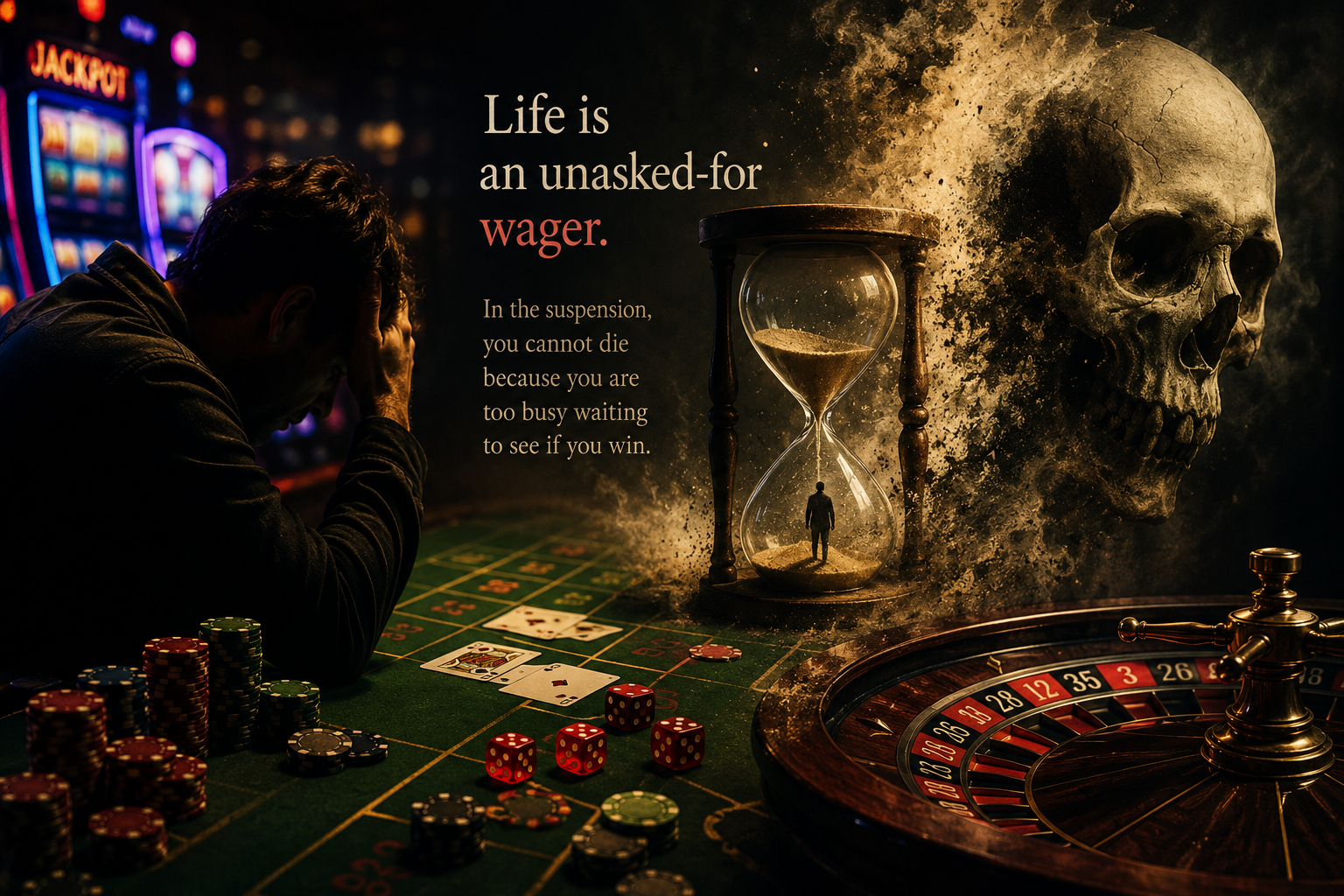
Philosophically, this is why gambling is so intoxicating: it mimics the ultimate stakes of human existence. Life is, after all, an unasked-for wager. We are dealt a hand of genetic and environmental cards, forced to bet our limited time on careers, relationships, and beliefs, with absolutely no guarantee of a payout and no option to fold.
In the suspension, time stretches. You escape the slow, grinding awareness of aging. For a fraction of a second, you cannot die because you are too busy waiting to see if you win.
The Beautiful Ruin
There is a darker current running beneath all of this: the gambler who wants to lose, or rather, the gambler who finds themselves repeatedly drawn toward the edge of the cliff.
In literature, philosophy, and psychoanalysis, this tendency is often associated with the concept of the death drive. It is the strange, subconscious urge to destabilize ourselves, to dismantle certainty, and to risk destruction simply to discover what lies beyond it.
When the final card falls and the chips are swept away, the silence that follows feels strangely grave-like. It is a total loss of agency. The gambler is stripped of power, reduced to nothing, forced to confront the hard reality of an indifferent universe that never cared which way the roulette wheel landed.
Yet the moment the next bet is placed, a small resurrection occurs.
Ultimately, gambling is not a search for wealth but a negotiation with time. It is an attempt to crowd out the quiet, creeping certainty of our ultimate demise with loud, artificial crises that we can actually survive.
We play because, in the frantic alternation of winning and losing, we briefly forget that the house always wins eventually.